
Starting, Growing, and Selling DataAnalyst․com: 24 Months, 230K Visitors, 1M Pageviews, and What I Learned Along the Way
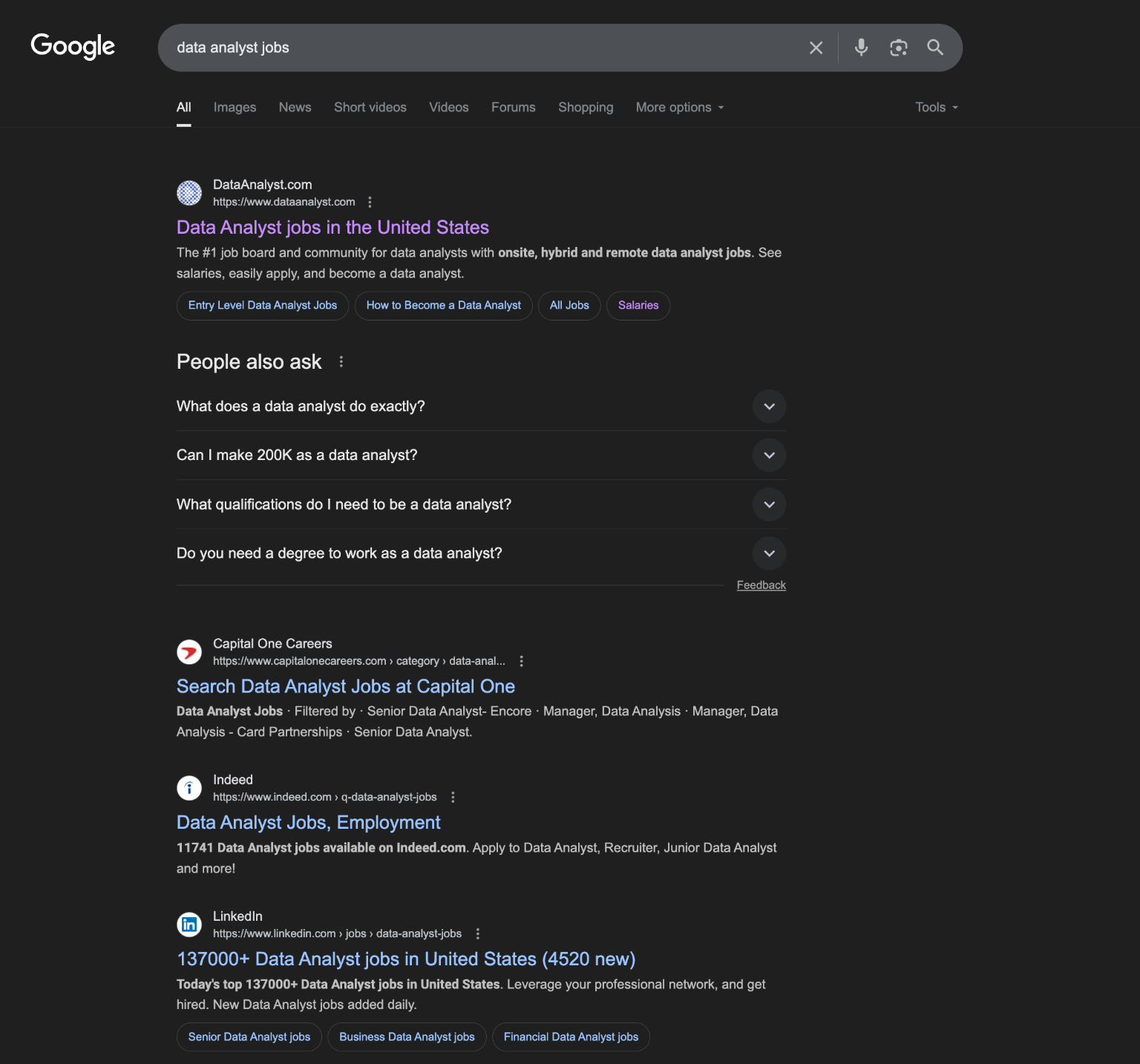
In early 2025, DataAnalyst․com was the #1 result on Google for ‘data analyst jobs,’ outranking Indeed and LinkedIn. It attracted 230,000 visitors, generated over a million pageviews, and helped thousands of people find work. It also made almost no money. This is the story of how I built a platform data analysts loved, but a business that wasn’t sustainable (or to be brutal to myself, a business that I couldn’t monetize).
On December 19th, 2022, I launched DataAnalyst․com with a simple vision: become the #1 job board for data analysts by hand-picking interesting opportunities across industries.
This is the complete journey - 24 months of building in public, with all the stats, failures, and lessons that came with it.
I’ll share everything I’ve learned about launching a project, building an audience, optimizing for search engines, and running a (not-very-sustainable) business. Whether you’re considering launching your own niche platform or simply curious about what it takes to build something meaningful from scratch, I’m hoping this post gives you the tactical insights and honest perspective you need.
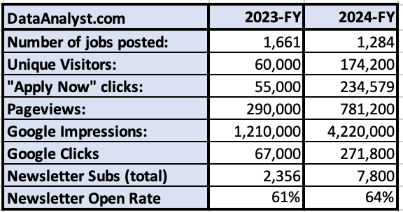
Before we start, I’ll leave some Statistics here, to showcase the scale that the project reached in the two years.
Over 24 months, 230,000 visitors submitted nearly 300,000 job applications for approximately 3,000 data analyst job opportunities posted on the site (all including salary ranges).
On the more detailed note, the site notched over 1 million pageviews, with a 50/40/10 split in terms of the traffic sources.
50% organic, 40% direct, 10% social.
After periodic clean ups, there were approximately 7,800 newsletter subscribers, with an average open rate 64% over the 2 years.
Now, there’s one thing I really want to highlight considering that I’ve spend exactly $0 on content, marketing, ads etc. (and I’ll rant about the SEO rollercoaster throughout 2024 later on).
By early 2025, DataAnalyst․com was ranking #1 in the United States for “data analyst jobs” on Google - ahead of Indeed, LinkedIn, and Glassdoor, and keeps a spot on the first page for “data analyst” - on exactly $0 marketing spend.
That still makes my day.
Now, here’s a table, and you might be wondering how did this actually happen? It started with a few key decisions that probably saved my ass later on.
Chapter 1: Foundation and Strategic Decisions
The Domain Decision (And Why It Saved My Ass)
I’m a firm believer in category-defining domain names. I’ve been building a portfolio for about 10 years because I believe they’re key to growing a successful business.
There were a few reasons for going with the exact match .com domain:
Instant credibility - and I’ll repeat it again - instant credibility matters more than most entrepreneurs realize. When I started talking to HR departments and introducing DataAnalyst․com, there was an immediate shift in how conversations unfolded. The exact-match domain eliminated the need to explain what we did or justify our legitimacy. Decision-makers didn’t question our intentions or authority in the space - the domain spoke for itself.
Start as you mean to go on - This meant fully committing to the project and planning for success from day one. Too many side projects fail because founders hedge their bets and never fully commit. By investing significantly in the domain, I was forcing myself to take the project seriously and see it through the inevitable challenges ahead.
Long term asset - No matter what happens with the site, the domain name will hold value over the long term. Even if the job board experiment failed completely, the domain would retain and likely increase its value over time as the data analyst profession continued to grow. This provided a safety net that made the risk more palatable.
This decision would prove crucial later when Google decided to play algorithm roulette with my traffic.
Key Takeaway: The Power of a Category-Defining Domain.
An exact-match domain isn’t just a web address; it’s a strategic asset. It grants instant credibility, forces commitment, and provides a durable safety net against market volatility and algorithm shifts. This “unfair advantage” proved to be the project’s lifeline.
Brute-Forcing The Two-Sided Marketplace Challenge
Building a job board means solving the classic chicken-and-egg problem: you need jobs to attract candidates, but you need candidates to attract employers. Rather than trying to solve both sides simultaneously, I chose to “hack” one side of the marketplace by manually curating high-quality job postings myself.
In the early days, I would be posting between 10-15 jobs daily, looking to brute-force the marketplace conundrum and bring initial traffic in. At the same time, I knew this was not sustainable in the long run, particularly on the monetization front - if companies see jobs added by me for free, why would they engage themselves?
This approach was a deal with the devil. By providing all the value myself, I was single-handedly solving the user’s problem, but I was also training companies to see the platform as a free service. Every job I posted was a vote for user experience but a vote against future revenue. I was consciously choosing audience growth over building a monetizable habit, a decision that would define the next two years.
On the positive side, it allowed me to maintain complete control over quality and ensure every job posting met my standards. I committed to only posting jobs that included salary ranges, even though this decision was controversial and significantly limited the number of jobs I could post, especially in markets like the UK and Europe where salary transparency is non-existent (this was prior to the EU directive on salary transparency that came into law in June 2026).
Could that problem be solved by posting jobs without a salary? Yes, it probably could, and it would definitely increase the amount of jobs posted for certain countries. On the other hand, I hate not knowing what the salary range is when applying myself. I remained committed to my approach to only have job listings with salary posted, even if it meant slower initial growth.
This quality-first philosophy became the defining characteristic and strongest competitive advantage.
Users began to trust that every job on our platform would include transparent salary information, setting us apart from larger job boards where this information was often missing or vague.
Key Takeaway: Solve One Side of the Marketplace First.
Instead of trying to attract both employers and candidates simultaneously, I brute-forced the supply side by manually curating high-quality jobs. This established a standard of quality (salary transparency) that became a core competitive advantage and built initial user trust.
The Launch and The Painful Pivot: Dropping Europe and UK
In the first month after launch, DataAnalyst․com attracted 795 users with 634 “Apply Now” clicks, averaging 3 minutes and 52 seconds session duration across 4,100 pageviews. The returning visitor rate was 17.7%, and Google sent us just 410 impressions - a number that would seem laughably small compared to later performance.
One of the early strategic decisions I had to make was geographic focus. When DataAnalyst․com launched, I aimed to bring data analyst jobs from the US, UK, and European markets.
After 3 months, I made a difficult decision - Europe and UK were no longer being covered, focusing purely on US market.
Why?
-Europe: Salary transparency is non-existent in most European markets. Out of jobs that included salary, majority were in local language.
-UK: Lack of salary transparency, plus the market is largely operated by recruitment industry, resulting in lower number of direct company listings.
I simply realized I wouldn’t be able to consistently add quality data analyst jobs for these markets, which would eventually lead to poor job seeker experience - if there aren’t quality enough listings being added over the course of the week, you’re extremely unlikely to come back.
This geographic focus proved to be the right decision. By concentrating efforts on the US market, where salary transparency laws were more favorable (or at least, a larger number of jobs for me to sift through) and direct company postings were more common, I could maintain higher quality standards while building a more engaged user base.
The Tech Stack: No-Code Reality
My setup:
Webflow - Website + CMS
Airtable - Database with job posts
Make - Automating the flow
Jotform - Form + Stripe payments integration
Buffer - Social media posts scheduling
EmailOctopus - Newsletter
Nocodelytics - Event analytics (particularly clicks)
As someone who couldn’t “code myself out of a box,” I built both DataAnalyst․com (and BusinessAnalyst․com) using a no-code tech stack. This decision shaped every aspect of the project’s development and taught me a few lessons about the trade-offs between speed and flexibility.
When it comes to no-code solutions, they are brilliant in the sense that they can provide a few pre-built blocks so one can quickly stitch up a working prototype, or even a simple end-to-end solution. However, either the feature that you need is available in the core proposition, or one has to custom code it and integrate themselves. Another option is add-ons with monthly subscription fees, but those get expensive quickly. While I’m fine spending on assets like domain names, I wasn’t excited about stacking subscription costs.
Let me illustrate this with a concrete example that annoyed everyone, including myself, on the platform for months.
I received multiple follow-ups from people mentioning how there were quite a few expired job posts on the site. If I put myself in the shoes of the visitor, I’d honestly be annoyed too. The no-code solution within Webflow was to auto-archive job postings after 45 days. While simple, this would probably clean up 80% of expired posts, but it would still miss out on some expired listings and archive some that were still active.
The optimal solution would be to offer a button or emoji for people to report expired jobs, display the reported count on the posting to inform others, and auto-archive based on a certain threshold. This would be effective, but I was successfully failing all my experiments with implementing this. The limitations of the no-code platform meant that what seemed like a simple feature request became a complex technical challenge that I couldn’t solve without custom development.
Eventually, I’ve solved for this with an email form link - every time someone would click it and marked it expired, I’d receive an email and could make an update. You’d be surprised (or maybe not, I know I was) how many times would people report jobs as expired, while they were still active. Getting rid of the competition, eh?
Important lesson here for those building with no-code tools: the 80/20 rule exists, and it works for a reason. Perfect solutions often require custom development, but 80% solutions can still provide tremendous value to users. The key is learning to embrace these limitations rather than fighting against them constantly.
Things take time, things break, and little annoying bugs add up. It’s something that I have been trying to figure out how to address. When it comes to putting together a few lines of code from scratch to fix an issue or deploy a new simple feature, I am absolutely clueless (or, I was - since this write up comes almost 2 years after the sale, and AI tools are now a norm, things dramatically changed, as you’ll see from the future articles). This reality meant that every technical challenge required either finding a workaround within the existing no-code ecosystem or simply accepting that certain features wouldn’t be possible.
Key Takeaway: Embrace the 80/20 Rule - it exists, and works for a reason
No-code tools offer incredible speed but have inherent limitations. Fighting for a “perfect” 100% solution leads to frustration. Acknowledging that an 80% solution can still deliver immense user value is crucial. The key is to work with the platform’s constraints, not against them.
With the tech foundation set, I needed to figure out how to get people to actually use this thing.
Chapter 2: Building in Public and Early Growth Strategies
The Reddit Experiment That Changed Everything
Building in public is scary - but it is a huge opportunity to learn something new, improve your work, and grow.
With that in mind, I decided to publicly share my journey of building DataAnalyst․com on Reddit, specifically targeting communities where data professionals gathered.
As most people probably know, you never know which way the comments section is going to go, so I was understandably nervous about putting my work out there for public scrutiny. The feedback, however, was overwhelmingly positive, and the first post racked up over 45,000 views. I was incredibly thankful for everyone who interacted with the post and shared their thoughts.
Going through the comments there were a few lessons about building in public.
First, authenticity resonates with people. Rather than trying to present a polished, perfect version of the project, I shared the real challenges, uncertainties, and learning process. People could sense this authenticity, and they were more likely to support a project where they understood the real challenges involved.
Second, building in public creates accountability. By committing to document the journey and keep myself honest, I established a rhythm of monthly updates (I did skip summer updates tho) about statistics, progress, thoughts, and next steps. This public accountability helped me stay focused and consistent, even during difficult periods when progress felt slow.
Third, the community feedback was invaluable for product development. The comments and direct messages I received helped me understand what users actually wanted, what pain points they were experiencing, and what features would be most valuable. This feedback loop became crucial for prioritizing development efforts and ensuring I was building something people actually needed.
Key Takeaway: Build in Public with Authenticity.
Sharing the journey, including the struggles and uncertainties, resonates deeply with communities like Reddit. This authenticity builds trust, creates public accountability that forces consistency, and generates an invaluable feedback loop for product development.The Power of Consistent Documentation, thus Making Yourself Think
As I mentioned, I committed to publishing monthly updates documenting traffic statistics, revenue (or lack thereof), challenges faced, and lessons learned.
The monthly updates served multiple purposes beyond just building in public. They forced me to regularly analyze what was working and what wasn’t, creating a natural rhythm of reflection and course correction. They also built trust with the community - people could see that I was being genuinely transparent about both successes and failures.
Additionally, I had multiple people reaching out, both in comment sections of my previous updates and in direct messages, sharing that they had found the site extremely useful in their job search and that they were able to get interviews and onboard new roles through the site. I absolutely loved hearing this, and even if the venture didn’t end up being commercially successful, I was super happy to hear that it had indeed helped people when needed.
This feedback became one of the most rewarding aspects of the entire journey. While revenue remained elusive from start to the end, the knowledge that the platform was genuinely helping people find better opportunities provided motivation to continue during challenging periods.
Newsletter Strategy: Quality Over Quantity
Building an engaged email list became one of the most valuable assets of the DataAnalyst․com project. Rather than focusing purely on subscriber growth, I prioritized engagement and value delivery.
When starting, I wanted the newsletter to be sent on a weekly basis, containing the latest jobs. The more I thought about it, the more I became against the idea - after all, people could visit the site and see the jobs, so why spam their emails? At the same time, the point of the site was to help people find a role - once they found one, they wouldn’t really need weekly emails with the latest jobs.
The format I settled on was once per month, containing insights, interviews, and educational content. This approach was seeing a consistent 60% open rate with less than 1% unsubscribe rate, clearly indicating that it provided genuine value to subscribers. The high engagement rates validated that quality content delivered less frequently was far more effective than frequent, low-value communications.
Overall, newsletter open rates stayed pretty consistent at around 60%, with click-through rates hovering between 5-7%, indicating it wasn’t just opens but actually people clicked through to read and engage with the content. I didn’t want the list to grow just for the sake of a bigger number, so I went through periodic pruning, unsubscribing people who hadn’t opened any of my emails over a period of time.
This quality-focused approach meant that while the list grew more slowly than it might have with more aggressive tactics, the subscribers who remained were genuinely engaged with the content and more likely to take action on job opportunities or recommendations.
There are a couple of main lessons learned I’d like to highlight:
Start segmenting early- it honestly took me way too long to simply expand the newsletter subscriber form, to include a checkbox with what type of jobs people would like to see (based on the years of experience).
Get to know your audience, it’ll help you.
You’ll get to better understand their needs, and you’ll get more information any time you’d engage in discussions with potential sponsors.
Sending emails is expensive, that’s what everyone will tell you.
If you want to save money on sending emails, you’ll probably be tempted go self-hosted, or be tempted to apply discount on an up-and-coming provider.
If you go self-hosted, you’ll probably need to stay extremely on top of things - from technical authentications, trust signatures, configurations, email warmups (and no, I don’t mean jumping jacks).
And if you don’t manage to stay on top of things, you’ll discover pain.
In April 2024, I’ve discovered pain.
Long story short, within a day I was back with the original provider, paying up.
An additional learning on running a Newsletter - since I took pause with the newsletter over the summer, I was quite excited to get the next edition out.
What I didn’t really foresee is that going couple of months without sending it, would have a trickle down effect on the deliverability, almost as if it was throttled to prevent spam abuse…
Key Takeaway: Prioritize Engagement Over Growth.
A smaller, highly-engaged email list is far more valuable than a large, passive one. By delivering high-value content less frequently (monthly insights vs. weekly job spam), I achieved a 60%+ open rate. Always segment your audience early to personalize content and maximize relevance.
University Outreach: Learning from Failure
Over the first summer, I noticed quite a few .edu emails signed up to the newsletter and thought it could be an interesting angle to explore, reaching out to universities and sharing that their students were using the site. I was hoping this would lead to both driving in visitors and potentially getting backlinks that would help increase the authority of the site.
So, I developed a strategy for building relationships with universities and educational institutions. This initiative could become a case study in how not to approach institutional outreach.
My first attempt was what I later classified as a surprisingly spectacular fiasco, although in retrospect, it couldn’t have ended any other way. I found an Excel spreadsheet online with approximately 1,700 educational institutions in the US and their admissions email addresses, then sent a mass outreach campaign.
Mistake #1 was timing - I thought that with universities and colleges starting in September, it would be a good time to get on their radar just as new students were coming in and discovering what those institutions had to offer. The truth was, it was also the time when there was an enormous amount of freshers spamming the admissions office looking for directions to their dorms.
Mistake #2 was audience - admissions offices do not care about anyone reaching out to build partnerships; literally, that’s probably the last thing on their mind. Put the two together, and I ended up with 2 “thanks but no thanks” replies out of approximately 800 emails sent. The silver lining was that the email still had approximately 50% open rate, so no harm was done to email deliverability.
So, I decided to tailor my approach. I pulled together a spreadsheet with information about the university, career center or course details (like MSc in Data Analytics), direct links to sections where they were currently sharing resources, and emails for both someone from the department and the career center.
With 30 institutions identified, results were much better this time (I’ve done it with 5 follow-up emails) - I gained 3 backlinks to DataAnalyst․com and one backlink to BusinessAnalyst․com (that’s a story for another time).
Great lesson here about targeted outreach versus mass communication, the importance of reaching the right person within an organization, and the power of follow ups.
Key Takeaway: Targeted Outreach Trumps Mass Communication.
A mass email campaign to 800 generic addresses yielded almost zero results. A meticulously researched, personalized campaign to 30 specific contacts, followed by persistent follow-ups, successfully secured valuable backlinks. Quality of outreach, not quantity, is what moves the needle.
All these growth tactics were working, but I knew posting jobs and sending newsletters wasn’t enough. If DataAnalyst․com was going to last, it needed to become something bigger.
Chapter 3: Content Strategy - Building Authority Through Original Data
From the beginning, I knew that DataAnalyst․com needed to be more than just a job board - it needed to become an authoritative resource for the data analyst community. This content-first approach became crucial for both SEO performance and audience building, and it would prove to be one of the most effective long-term strategies I implemented.
Monthly Market Insights:
The initiative became a cornerstone of this strategy. It was a deep dive into the data analyst job market using our job data - which industries are hiring most, salary increases, remote working trends.
I knew this wouldn’t be extensive enough to highlight trends initially. But I believed monthly reports would provide long-term value - the more data points we collected, the more insights we could uncover.
This approach proved to be worth it, as these monthly reports eventually formed the foundation for our comprehensive salary guide.
Salary Guide:
With approximately 1,650+ data analyst jobs listed on the site by the end of the first year (and over 3,000 by the end of the second), I was able to analyze this data to develop a comprehensive data analyst salary guide that was updated quarterly.
The guide included data for the whole of 2023-2024 and provided visitors with salary breakdowns across multiple dimensions.
The industry breakdown showed specific industry data with overall minimum, maximum, median and average salary information, plus salary breakdown by years of experience.
The years of experience section broke down all jobs on the site by experience level: entry level (0-3 years), senior (3-5 years), and lead (5+ years).
The state breakdown was where things got tricky. As usual with this kind of exercise, lumping all the data together resulted in an insane range. On the other hand, if you split the data in 52 different ways, you get a whole different set of issues where the sample size isn’t large enough to draw any conclusions - and for some states, there was simply no data at all (not to single any state out, but I’m looking at you, Wyoming).
As an experiment and primarily targeting SEO benefits, I also included average data analyst salaries at all the companies that were listed on the site. Truth be told, until the amount of jobs per company got into at least double digit numbers, it was probably a useless metric, but I was hoping to rank for some of the long tail “what is a data analyst salary at X” keyword searches.
This salary guide became one of our most valuable pieces of content, both for users seeking salary information and for SEO purposes. It demonstrated the power of leveraging your own data to create unique, valuable content that couldn’t be found elsewhere. As the site grew and the number of jobs increased, this guide became an increasingly authoritative source of salary information, complementing what was already available on other sites.
Interview Series:
The “Day in the Life” interview series became another element of the content strategy. I shared our first interview on March 9th.
Over time, I published 17 interviews that brought different points of view, stories of growth, and shared unique paths that each individual took to navigate their careers. There was a ton to learn from these interviews: how to land a data role internally within an organization, the power of showcasing and reframing your experience outside the direct data analytics field, and how moving into more leadership roles requires more than just being a data wizard.
I’m incredibly grateful for everyone who shared their journey - this type of authentic, practical advice became the hallmark of our interview series and helped establish DataAnalyst․com as a trusted resource for career guidance.
Key Takeaway: Create Authority by Leveraging Your Own Data.
The most valuable content is the content that only you can create. By transforming our job listings into a comprehensive Salary Guide and sharing authentic user stories through interviews, we built an authoritative resource that couldn’t be easily replicated, driving both user trust and SEO performance.
Expanding Beyond Jobs: The Educational Directory Decision
By mid-2024, something was nagging at me. The salary guides were useful, the market insights provided trends, but I kept getting emails that made me realize I was missing a huge part of the story.
These weren’t from people looking for their next role - they were from students, career changers, and professionals trying to figure out how to break into data analytics in the first place. They had questions about education paths, degree requirements, which programs would actually prepare them for the roles they were seeing on the site.
The data analyst job market had shifted. What started as a hot field with plenty of opportunities had become increasingly competitive, especially for entry-level candidates. I was seeing this firsthand through job curation - requirements were getting stricter, experience expectations were rising, and the “self-taught” path that worked in the early 2020s was becoming less viable.
That’s when it clicked: if DataAnalyst․com was going to be more than just another job board, it needed to serve the entire career journey, not just the endpoint.
Building the educational directory became one of the most time-intensive projects I’d undertaken. What started as a “quick addition” revealed itself to be comprehensive research across hundreds of institutions in all 50 states. I spent weeks digging through university websites, program catalogs, and admissions materials (eventually I did get help on Upwork) - some institutions made information easily accessible, others buried it deep in their sites.
The goal was simple: make it as easy as possible for someone to find programs matching their specific situation, whether they wanted an Associate degree to get started, a Bachelor’s to build foundation skills, or a Master’s to advance their career.
From an SEO perspective, it also served a strategic function - capturing people at the beginning of their data analytics journey with long-tail education searches.
This wasn’t just about driving traffic - it was about nurturing people from the beginning of their data analytics journey and providing them with a complete resource that could guide them from education through to career placement.
How to Become a Data Analyst Guide:
Building even further on this knowledge base of interviews, insights and resources, I was super excited to launch the first version of The Data Analyst Guide - an in-depth guide to becoming a data analyst.
The guide brought together everything I’d been building: insights from these interviews were incorporated throughout the guide, along with our quarterly salary data and monthly market insights. It covered understanding the role and responsibilities of a data analyst, education and experience requirements, technical and soft skills, the well-known not-so-secret hack of building your own portfolio, and career development using our own salary guide data.
As the site continued growing, the goal was for the guide to be a living document - constantly evolving and incorporating new findings, advice and insights from our ongoing interview series and market analysis.
In all of these initiatives, the key was using our own data rather than external sources. People could tell the difference. But creating valuable content was only half the battle. The other half was fighting for visibility on the world’s biggest stage: Google. That journey deserves its own chapter.
Chapter 4: The SEO Rollercoaster: My Two-Year War With Google
For the first three months after launch, Google sent virtually no organic traffic to DataAnalyst․com.
Frustrating? Yes. But I wasn’t too concerned.
Why?
Well, in February and March the site still brought in just over 3,000 unique visitors - the results of my Reddit build in public efforts, as well as…yes, you guessed it… the domain name. Over 40% of that traffic was direct - meaning people directly typing in the domain name in the URL.
Then, in April 2023, the site finally started ranking for “data analyst jobs” searches, gaining impressions and clicks that accounted for about 20% of that month’s visitors.
I was super happy to see this breakthrough, as having multiple traffic channels is crucial to long-term growth and protecting the site from algorithm updates. SEO is truly a long game, and it can take months for a new domain to gain trust and authority with search engines.
This initial breakthrough was encouraging, but to truly compete, I knew I had to go beyond just waiting. I had to get my hands dirty with the technical side of SEO - even the parts I didn’t particularly like.
I spent considerable time over the first summer using tools such as SEMRush, Ahrefs, and Moz to run high-level audits and understand how the site performed on the SEO front. This led to significant time spent making on-page changes to improve keyword optimization, rewriting meta descriptions, and adding alt descriptions to all the images on the site.
This was probably something that could (and should) have been done much earlier, but better late than never. Whether this was something that caused the sudden Google love, I don’t know, but it became something that I paid attention to with each update I made on the site going forward.
The structure I used was to programmatically target these long tail searches:
Data analyst jobs in p(State) - i.e. Data analyst jobs in Illinois
Data analyst jobs in p(City) - i.e Data analyst jobs in Boston
p(Industry) data analyst jobs - i.e. Financial data analyst jobs
p(Industry) data analyst salary - i.e. Financial data analyst salary
p(Experience) data analyst jobs - i.e. Entry level data analyst jobs
p(Experience) data analyst salary - i.e. Entry level data analyst salary
Data analyst salary at p(Company) - i.e Data analyst salary at Google
p(Experience) data analyst salary - i.e Entry level data analyst salary
And once I added the College / University directory, I expanded to target the education related searches:
Data analytics p(degree level) in p(State)
p(University) data analytics program
Online p(degree level) in data analytics
I also optimized data analyst jobs for Google Jobs Schema, so all the jobs posted on the site were immediately listed on Google Jobs as well, expanding the reach beyond traditional search results. This technical implementation definitely helped visibility, as Google Jobs became an increasingly important source of traffic for job-related searches.
Alongside these, I continued creating unique content through salary guides and professional interviews, and used indexing tools to immediately index new content.
Personally, as I mentioned in my updates along the way, I hated this approach - I was publishing somehow duplicate but not exactly duplicate pages, for the sole purpose of pleasing the SEO overlords. I understood that going a step too far would have a massive hit on user experience, so I tried to be very intentional to ensure the key information was consolidated and easy to find.
The results spoke for themselves, even if the process felt somewhat artificial.
This organic traffic growth continued to accelerate throughout 2023. By October, more than one-third of all Google impressions and clicks over the previous 10 months happened in that single month. Between optimizing for Google Search Results and Google Jobs, the site eventually saw over 5 million impressions on Google over the course of 2 years - almost 1 million of which happened from September to December, right after my summer optimization efforts. This dramatic increase validated the importance of technical SEO fundamentals.
The biggest win was being able to rank between 10th-20th place for “data analyst” search, as well as consistently showing up high enough to get some attention for “data analyst jobs” search, which drove most of the organic clicks. Considering I started the project on a domain with no history, no backlinks, and no authority, I told myself this was a massive success.
But in the world of SEO, success is temporary. Just when things seemed to be going well, the rollercoaster took a sharp dive.
Just when things seemed to be going well, Google released what would become known as the March 2024 Core Update. Since OpenAI hit the ground running with GPT-3.0 and people started utilizing LLMs to create content, Google Search had been caught out, unable to really comprehend the situation. From that moment, there had been monthly updates released, where Google was trying to address AI-generated content, update their algorithm, and figure out how to actually identify helpful content they could serve.
It had been a brutal year for most people who had built their projects, businesses, or blogs off Google organic search, seeing their traffic decimated. And it finally hit DataAnalyst․com as well. Even though I was always publicly questioning the accuracy of Google Search Console results when it came to impressions and clicks, the impact was undeniable when comparing to February 2024: impressions went down 33% and clicks took a 40% dip.
With that hit, the site also lost around 50% of keywords that it was previously ranking for, now not showing up in results for those at all. This was devastating from a traffic perspective, but it pretty much reinforced the importance of traffic diversification.
At this point, you might wonder how the overall numbers could still show growth despite this massive search engine hit.
The answer lay in the power of the exact-match domain and direct traffic.
Even with the massive “Search engine doesn’t like you anymore” hit, we were still able to cross an (at that time) all-time high in terms of unique visitors, still contribute to over 14,000 job applications made, and still grow our newsletter subscriber base.
Recovery was gradual through summer, with August hitting all-time highs. But this was short-lived - another August update knocked us down again.
This cycle of updates, recovery, and new updates became a recurring theme throughout 2024. From August to December 2024, Google Impressions were down by 35%, and Google Clicks dropped a whopping 52%. On the clicks side, the site was now below start-of-year numbers, demonstrating just how volatile relying solely on organic search could be.
Do you remember what I said from the beginning about domain investment?
I stand by my statement - now more than ever, category-defining domain names give you an unfair advantage on the market, no matter what is happening around you.
Whatever Google did, there were still over 5,000 people who typed in the domain and came directly to the site each month.
This direct traffic became a lifeline during the most challenging periods and demonstrated the long-term value of investing in a premium, exact-match domain.
And, here’s a big, big kicker - even with all the SEO rollercoaster throughout 2024, by early 2025, as I was handing over the project, DataAnalyst․com was showing up as the #1 result in the US for “data analyst jobs” searches, and on the first page for “data analyst” (#5 result).
Chapter 5: Monetization Challenges and Market Realities
The Revenue Reality Check
All this SEO success was great, but there was still the matter of actually making money from it.
After 2 years of operation, DataAnalyst․com had facilitated over 300,000 job applications, built an audience of 7,500+ newsletter subscribers, and achieved consistent top-3 rankings for competitive keywords. Yet the harsh reality was that paid job postings - my intended primary revenue source - had generated only a handful of sales throughout the entire journey.
From a monetization perspective, my original thinking was that paid job posts would be the primary revenue driver. While that may in the future be the case, at least in the first year it fell very short of expectations.
The simple reason was that I did not really do any sales. Honestly, full stop.
I couldn’t expect organizations to proactively find the site, with very little historical authority, and pay for a sponsored job post.
It took 7 months and 16 days to get the first paid job posting on the site. Tualatin Valley Fire & Rescue purchased a fast-track job posting, and it came organically, which was a great sign. However, this also came with a lesson learned - after tweaking flows and forms, always double-check that you didn’t leave a bug behind. Unfortunately, I had left a bug that prevented them from completing the purchase, but fortunately they reached out and I solved the issue immediately.
By the end of 2024, the total number of paid job postings for the year was just 6. You can do the math on how that particular revenue stream was performing. This stark reality forced me to confront the gap between my assumptions about monetization and the actual market conditions.
Understanding the Job Board Monetization Landscape
Through conversations with other job board operators and industry observation, I identified five main ways to monetize a job board, each with its own challenges in the market environment.
Reverse job board model: (RailsDevs) has candidates create profiles while companies pay for access to the pool and then pay a percentage commission on hire.
Jobs aggregator model: (RemoteOK) benefits from in-demand role types and massive traffic as the differentiator and driver of inbound sales, monetized by companies posting job opportunities.
Job board plus services model: (like KeyValues with engineers) uses the job board as the top of the funnel, with main revenue coming from additional services like coaching, agency work, or recruiting.
Niche job board model: (like DataAnalyst․com, RanchWork, or SEOJobs) relies on owned niche audiences and sells jobs through inbound or outbound efforts for better candidates.
Finally, the aggregate niche job board model: (like RemoteRocketship or EchoJobs) aggregates niche jobs en masse and is monetized through candidates - showing X jobs for free while having candidates pay weekly, monthly, or yearly to get access to all listings.
From my conversations and observations, most models were currently struggling on the revenue side. This was primarily because of the shift in the job market - while 2020-2022 saw massive hiring with employees having the upper hand, 2023 onwards shifted to hiring freezes, layoffs, and companies being in control.
There were hundreds or thousands of qualified applicants applying to tech jobs, and companies could have their pick. They didn’t really need to be advertising or using extra channels to reach applicants because they were already being flooded with applications.
Key Takeaway: Your Business Model Must Adapt to Market Realities.
The job board market shifted dramatically from an employer-driven to a candidate-driven landscape. This made the original monetization plan (paid job posts) nearly obsolete. Success depends on recognizing these macro shifts and being willing to pivot your model accordingly.
The Broader Industry Struggles
This market shift translated directly to job board revenues across the industry. RailsDevs was down around 85%+ from peak, and RemoteOK was down 70%+ (the owner actually recently asked publicly how he could monetize his newsletter list with 1 million subscribers because he’d seen company paid job posts go down 90% from peak).
The model that was currently working best was RemoteRocketship and EchoJobs - with the brutal market conditions, applicants were trying to find and get access to all the jobs they could and were very much willing to pay for that access. The other model doing well was the job board plus services approach, but again, that revenue wasn’t coming from job posts but from support, CV help, coaching, mentoring, and courses.
This industry-wide struggle provided context for my own monetization challenges. It wasn’t just that I was doing something wrong - though let’s be honest, I wasn’t really doing anything at all. The entire job board ecosystem was being disrupted by fundamental changes in the hiring market.
Ads and Affiliate Considerations
A very simplistic view of this world is that aspiring and professional data analysts are an extremely valuable audience.
On the entry level side, people are usually driven, bright, in higher level education and searching for an edge how to enter the in demand and well paid industry. (Target audience for bootcamps, course and certification providers)
On the experienced, these are people with higher salaries, disposable income, and at a managerial level also in many cases decision makes on what tools, conferences etc. their division / team / company runs (target audience for tools, platforms and other tech providers as they are building up and scaling their propositions + leadership level certifications and coaching).
After a lot of internal arguments with myself, I decided to listen to some great suggestions from Reddit, to start offering an exclusive partnership with a sponsor, that wouldn’t be a detriment to on site experience.
I started thinking one highlighted sponsor per month, on the whole site + newsletter - this could command a much higher fee, and would expand potential clients, from only employers, to education providers, analytics tools etc looking to target analysts.
The added benefit is the network of both DataAnalyst․com AND BusinessAnalyst․com, where for the time being I can offer same BusinessAnalyst placement as part of the package.
With that in mind, I’ve downloaded a dump of all companies paying for Google Ads, over the 12 months. Particularly targeting same keywords that I can offer them direct audience to, through the site. (i.e Data Analyst / Data Analytics + courses, certificate, tools, bootcamps etc)
In the first 8 months of 2024, that made around 120 organisations - ranging from educational institutes, startups offering data analytics tools, to bootcamps and career tools providers - who target some of these specific keywords, and have actively spend on getting those ads up in search results.
Doing some initial research on other advertising platforms, if we take the segment of bootcamps / courses / certifications, the top 5 advertising organisations pay upwards of $100,000 a month on Google ads, to reach (imho) minuscule appx 16,000 clicks combined ($6.25 cpc) from their target audience.
The people visiting DataAnalyst ARE the exact audience these companies are trying to reach, all on one site + directly reachable and responsive through a growing newsletter.
As I started to reach out, the response rate was higher than what I expected (considering it’s a big challenge to find the right contact/budget owner), but what I did hear from about a third of companies was that none of them have budgets, or had their budgets cut for marketing.
I found this to be quite fascinating, they’ve been perfectly OK to spend money on Google ads, but somehow they didn’t have money for sponsorship and partnership with a media company that would get them exactly in front of the audience they are so desperately trying to reach.
But, obviously, that’s not my call and just something that I would need to accept.
The Final Chapter: Measuring Success Beyond Revenue
When Traditional Metrics Don’t Tell the Whole Story
After two years of building DataAnalyst․com, I found myself in an interesting position. The traditional metrics of business success - revenue, profit - painted a picture that was, frankly, disappointing. But those numbers only told part of the story, and perhaps not even the most important part.
Throughout the journey, I had people reaching out constantly. They came through comment sections on my Reddit updates, through direct messages, and via email. The message was consistent: they had found the site extremely useful in their job search, they were able to get interviews, and many had successfully landed new roles through opportunities they discovered on DataAnalyst․com.
I absolutely loved hearing these stories. Even though the venture didn’t end up being commercially successful in the traditional sense, I was genuinely happy to know that it had helped people when they needed it most. This human impact became one of the most rewarding aspects of the entire journey and provided the motivation to continue during the most challenging periods.
There’s something profound about building something that genuinely helps people, even when it doesn’t help your bank account. Every email from someone who found their dream job, every message from a career changer who successfully transitioned into data analytics, every note from a student who used the educational directory to find the right program - these became the real measures of success.
The Honest Assessment: ROI and Future Decisions
But let’s be brutally honest here. By Q4 2024, the main question bouncing around in my head was about return on investment and long-term sustainability. While my costs were reasonably low (although not insignificant for where I live), and it helped that I could reuse the same tech stack for both BusinessAnalyst․com and DataAnalyst․com - theoretically spreading the risk - the numbers just weren’t adding up.
There were avenues I could have explored more aggressively: CV help, mentoring, coaching, or creating my own products. But I just didn’t have the bandwidth. The internal conversations in my head were constantly bouncing between different scenarios for what came next.
The worst-case scenario wasn’t actually that bad. I could take the learnings onto something else, maybe see if those who had followed this journey would like to stay in touch, take both sites down, and be left with the two domains. From my personal experience with domaining, that wasn’t such a terrible outcome.
On the other hand, I could see the sites being used daily. I could see them helping people. There was now a large list of loyal newsletter subscribers who were getting genuine value from the content I was creating. Job markets are cyclical, so the real question was whether I could last until the tide shifted back in favor of job boards and hiring.
The main investment had always been time, and I had been in a real crunch during the second half of 2024. All of this work was happening in early mornings, late evenings, and weekends, alongside my demanding day job. Something had to give.
The Monetization Reality Check
This brings me to a hard truth about building projects: there are things you think you can do at the start of a journey that reality eventually forces you to confront. When I began, I thought I could monetize through organizations posting jobs, through ads, through CV reviews, through coaching, through sponsorships, or by creating my own products. All of these seemed like they were on the table.
But when it came down to actually executing, when you grow and realize what aligns with your personality and values, some of these options become non-starters. I know people say you need to be able to sell, and I’ll acknowledge that weakness, but there are other issues at play.
For example, even simplest things such as the fact that I hate ads. I use an ad blocker myself. I don’t want people to be swarmed with advertisements when they’re trying to find career opportunities. Similarly, on the affiliate side, if I don’t use a product myself, I wouldn’t feel comfortable recommending it to others. It comes down to this: people are looking for jobs, the job market is brutal, people are losing their livelihoods. Recommending a course that costs thousands of dollars without having gone through it myself? That’s just not how I want to operate.
I understand that people build things, spend time creating value, and deserve to be compensated properly for that value. But there are some business models for job boards that I internally struggle with. In the current economic environment, I just couldn’t bring myself to be the person or product that starts charging job seekers to view job listings. I understand the value that job boards provide through curation and aggregation, but it still doesn’t sit well with me to put even more financial pressure on people who are already struggling to find work.
Looking back at those seven or eight different monetization streams I had initially considered, I realized I wasn’t either the right person for most of them, or I simply couldn’t make progress on them. The remaining options - sponsorships and in-depth research partnerships - were largely out of my hands, dependent on external factors and requiring sales skills and bandwidth I simply didn’t have.
This is the reality of building a side project alongside a day job. No bandwidth, no time, and if I’m being honest, by the end of 2024, with everything going on in my life, I had hit a rut. It became a grind, and I had to get my priorities straight about where my income was actually coming from.
The Decision and What It Meant
I won’t go into details about who acquired DataAnalyst․com - when they decide to share that information, they will. We agreed to keep the financial details private on both sides, which I’m going to respect completely. But I can share this: looking purely at the numbers, those traditional business metrics, the two years weren’t profitable for me. I spent an enormous amount of time on the project, and from a pure ROI perspective, it didn’t make financial sense.
But - and this is a big but - I probably learned more over those two years than I had in the previous decade of my career.
There are silver linings that I can’t ignore, because I honestly can’t look back at two years and call it a waste of time. It absolutely wasn’t. On a personal level, I had decided to take something and build it from scratch, from nothing, and when I look at the non-monetary metrics of what I was able to achieve, I’m genuinely proud.
Think about this: I managed to get DataAnalyst․com ranking at the top of Google results, competing directly with Indeed and LinkedIn, with essentially no money spent on content or SEO. There are companies spending tens of thousands of dollars monthly just to achieve those rankings. I did it on no budget, operating entirely in my spare time.
I look at the analytics showing 230,000 people who found value in something I built from scratch - people learned something new, people found jobs, people contributed their expertise and experience to help others. There were fantastic professionals working at incredible companies who thought what I was building made sense and decided to help out.
The Learning Journey: From Idea to Execution
From a technical perspective, I had to learn everything from scratch. Coming up with the idea, researching its viability, building the site as a non-technical founder using various tools and integrations, then spending two years fixing bugs, developing new features, and enhancing what was already there.
I had to put myself out there on Reddit and other social media platforms, sharing what I was doing with others, listening to feedback, taking criticism constructively, and constantly improving the user experience. Every single thing that someone would have to do to start from nothing - from a blank piece of paper - and build something meaningful, I went through as a solo builder.
The power of consistency became crystal clear. I spent roughly 30 minutes every day on the project. Okay, maybe that’s not entirely accurate - there were days when I spent much, much, much more, but the consistent effort of showing up daily, making small increments of progress, compounded over time.
How much can one person achieve by dedicating just 30 minutes every day for two years? The answer, as it turns out, is quite a lot. That daily commitment to moving forward, even in small steps, created a foundation that supported everything else.
The amount of things I had to learn over those two years was genuinely insane, and I haven’t even shared half of it in this writeup. Website development, growth tactics, content creation, UX/UI design, SEO optimization, social media strategy, data analysis, and yes, even some sales skills (though clearly not enough).
What’s Next: Building on the Foundation
I want to take what I’ve learned and push it further. The skills I developed - building sites, implementing growth tactics, writing, creating content, tinkering with design, understanding SEO, managing social media, analyzing data - these aren’t going to waste. If I don’t build on these learnings, it would be a genuine shame.
Over the last few months, I’ve already started putting something new together. I’m seeing that I can speed through certain aspects of launching a project because I now know where to look and what to watch out for. This time, I’m not limiting myself to no-code solutions. I’m embracing AI-powered coding, which has been genuinely fun and educational.
I’m not necessarily doing “vibe coding” as some people call it, but I now understand code structure and how full project ecosystems work. This brings much more flexibility to what I can build and how quickly I can iterate.
You’ll definitely hear from me about what I’m doing next. Maybe this is shiny object syndrome - probably, yes. But it’s also the natural evolution of someone who has learned what’s possible when you commit to consistent daily effort.
I’ll be dedicating at least 30 minutes a day to this new venture, just as I did with DataAnalyst․com. Maybe I could have reached the same conclusions after year one instead of needing two full years. Now I know what to watch out for and can make decisions earlier in the process.
The Broader Lessons: What This Journey Taught Me
Building DataAnalyst․com taught me that success isn’t always measured in dollars and cents. Sometimes the most valuable outcomes are the skills you develop, the people you help, and the proof of concept that you can build something meaningful from nothing.
The educational directory, the salary guides, the monthly market insights, the interview series - all of these components came together to create something that genuinely served the data analytics community. Even if it didn’t generate the revenue I had hoped for, it demonstrated that there’s real value in comprehensive, thoughtful resources that serve an entire career journey rather than just one piece of it.
The experience also taught me about the importance of aligning business models with personal values. Not every monetization strategy is right for every person or every project. Understanding your own boundaries and principles isn’t a weakness - it’s essential for building something sustainable that you can be proud of.
Most importantly, it reinforced the power of consistency and daily commitment. Thirty minutes a day, sustained over two years, can create something substantial. It might not always create something profitable, but it will always create something valuable - even if that value is primarily in the skills and experience you gain along the way.
The journey from idea to execution, from zero visitors to 230,000, from a blank domain to a comprehensive career and educational resource - that’s a journey worth taking, regardless of the final financial outcome. And now, armed with everything I learned along the way, I’m ready to take that next step and see what else is possible when you commit to showing up every single day.